Economy
Nobody Decided to Nationalise Sugar
How India’s government came to run its sugar industry one emergency at a time.
What happened
Last month the Indian government let foreign sugar in duty-free for the first time in almost ten years. In November it had allowed mills to export, in May it had banned exports, and in August it allowed imports. In between, the mill price of sugar spiked, the Food Secretary told reporters that traders were manufacturing a shortage, and his ministry authorised imports the day before he said it and capped stocks the week after. By 5 September the mill price in Maharashtra had given back the whole spike. Officials say the market has been brought under control. It has never been under more of it.
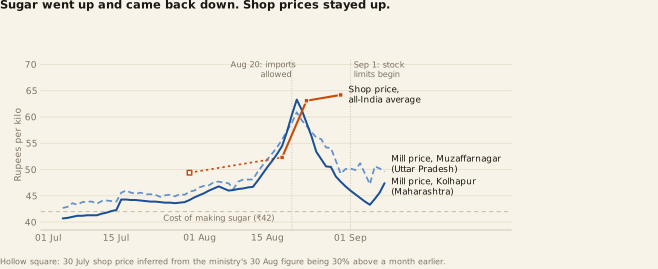
In early July Maharashtra mills were getting less for their sugar than the industry says it costs to make. Prices edged up through July and early August, then jumped by a third in the last ten days before 21 August, the day after the government announced duty-free imports. They then fell almost as fast as they had risen. Most of the fall was over by the end of August, before the bulk-buyer limit took effect on 1 September, though the dealer cap had been in force since 1 August and the bulk limit had been announced on 20 August. By early September Maharashtra prices had given back the entire August rise and sat a few rupees above cost; Uttar Pradesh gave back about two-thirds and settled roughly eight rupees above the national cost figure, though costs in UP run higher. Shop prices went up with the mill price. On the last date for which the ministry has published a figure, 30 August, they had not come down with it, and the gap between shop and mill was about 17 rupees against the 5 to 8 the trade calls normal.
Two things follow. The mills accused of profiteering in August had, in Maharashtra, been selling below the industry’s own cost estimate in July. And no one in the chain came out visibly ahead: the industry says only 100,000 to 150,000 tonnes were sold at the elevated prices, mills ended a few rupees above where they began, and shoppers, at last count, were paying 30 per cent more than a month earlier. Whoever sold at the top was a trader, and traders who bought at the top lost it back. The one party with more than it had in July is the ministry, which now decides who may hold sugar, for how long, and when it may be sold. None of this was proposed as a programme.
The theory
Friedrich Hayek argued in 1945 that the knowledge an economy runs on is scattered across millions of people, each knowing a little about his own circumstances and nothing about anyone else’s, and that no office can gather it in time. Prices do the gathering: a rising sugar price is the summed judgment of everyone who has noticed something about cane yields or mill stocks.
Ludwig von Mises supplied the second half, in his 1929 Critique of Interventionism and a 1950 lecture. A government that fixes one price finds that the adjacent markets stop clearing: a ceiling produces a shortage, a floor a glut. It must either abandon the first control or extend control to the next market. Since abandonment admits error, it extends, and the process continues until the state is directing the whole industry without anyone having decided it should. Mises’s example was a ceiling on milk. India’s cane floor produces the glut version, and the sequence runs the same way. Both men assumed officials are competent. Their point was that competence does not supply the knowledge the official lacks; the implication, though neither put it this way, is that each fix removes the signals the next one would need.
The chain
Delhi owned the problem before the season began. It fixes a floor price for cane, and several states fix a higher one. It fixes a floor under sugar. It settles how much cane becomes ethanol; that share has shrunk, but it was still several times this season’s shortfall, and was planned against a production forecast that failed. The sugar price was the government’s responsibility before a tonne was crushed, and that is the first fixed price in Mises’s sequence.
The export quota was set on a November forecast and expanded in mid-February, a fortnight before the industry cut that forecast by 2 million tonnes.
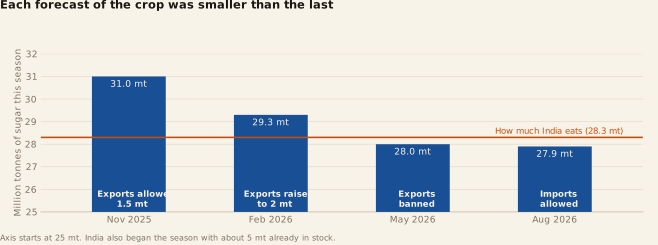
Read the bars left to right. Exports were permitted on the first estimate, widened in the month of the second, and banned once the estimate had fallen to the line. The government’s own current figure of 30.6 million tonnes is a gross number; net of roughly 3 million tonnes diverted to ethanol, it too falls below consumption. Nobody in the ministry was negligent. The number it needed in November, the sucrose in cane still standing in the fields, was available to no one. Treating a national estimate as though it contained that precision is an instance of what Hayek, in his 1974 Nobel lecture, called the “pretence of knowledge”: treating the measurable aggregate as if it were the thing itself. What the record does show is that the correction arrived and was not acted on. The industry’s cut came on 26 February, when about 200,000 tonnes had shipped; the ban came in May, by which time 650,000 to 800,000 had. A free market would probably have exported in November too. The difference is what follows: prices would probably have started rising as the shortfall became visible, making exports less attractive and giving traders an incentive to hold stock for the gap. Instead the quota stayed open for ten weeks after the cut and was then closed by decree.
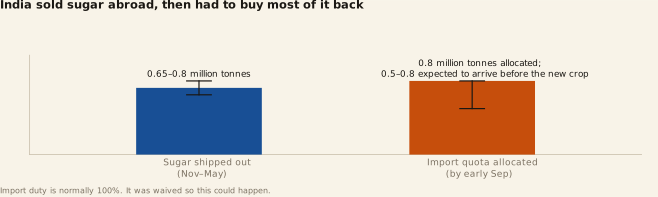
The ban was a correction on the same variable; the ratchet begins afterwards, when the state moves on to variables it had never touched. The cane price and the ethanol allocation, which shaped the supply, were left where they were. The import waiver then suspended a 100 per cent tariff to bring back a large part of what had been let out.
The price rose, and the government called the signal a fraud. Look again at the first chart: the peak in Kolhapur falls on 21 August, the day the Food Secretary said the rise was “not based on any fundamentals”, that stocks were ample, and that mills and traders were hoarding to create an impression of scarcity. The same chart shows the mills he accused sitting below the cost line six weeks earlier, and the longer view below shows them at or under it for most of the previous five years.
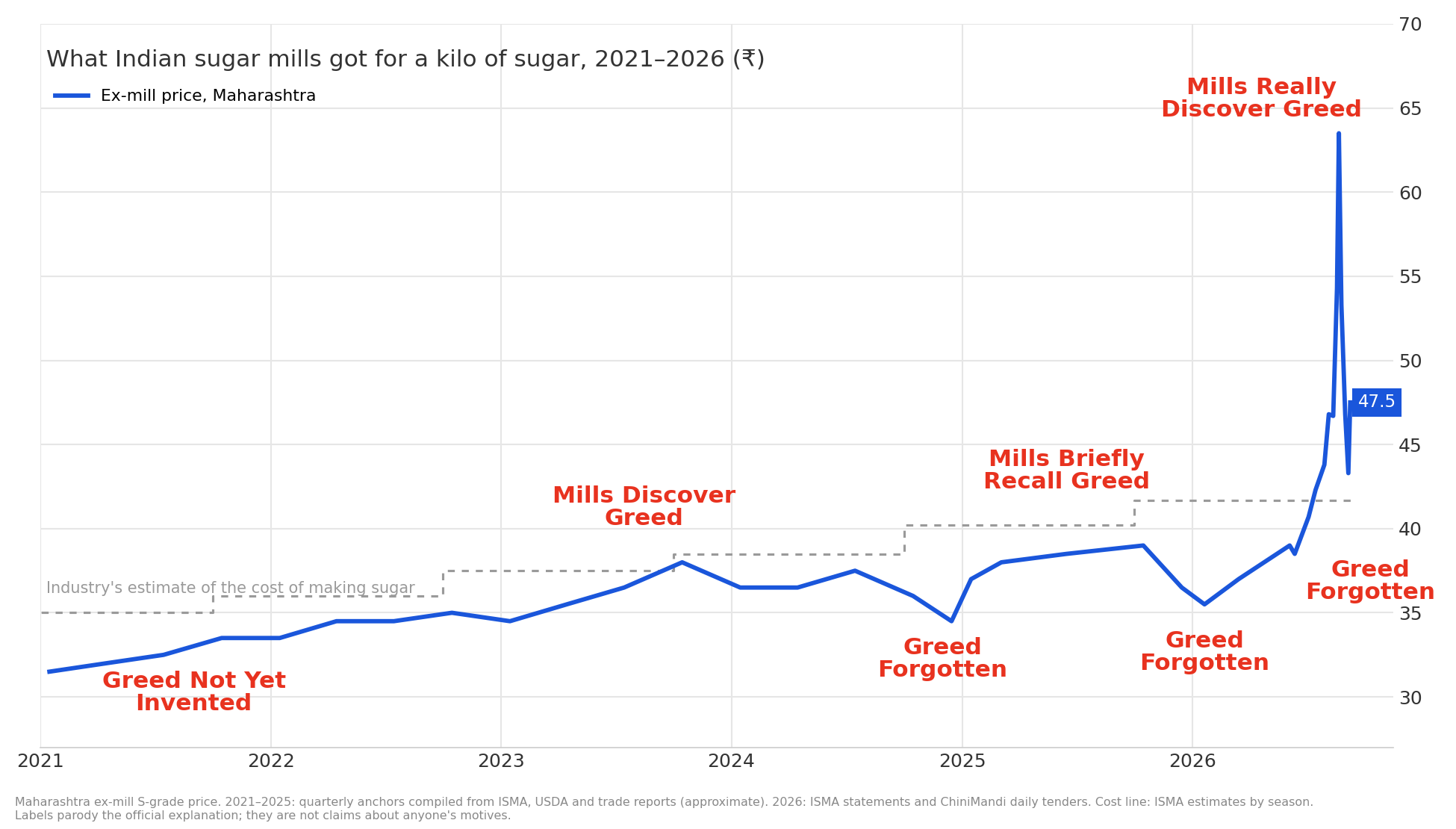
A day earlier his ministry had authorised the duty-free imports as a precaution. Its account is coherent: enough sugar, a speculative overshoot, an import threat to break it. What it omits is that the stock situation beneath the overshoot was real. India will close the season with about six weeks of consumption in hand, the lowest carryover since 2016-17, and the ministry’s own production figure, net of ethanol, implies output below consumption. Traders holding sugar in August were forecasting that with their own money. Whether the peak or the trough is the right price for a six-week cushion is a question nobody can now test, because holding sugar to find out is against the rules. The “paper sales” the Secretary cited fit the same reading: mills booked the sales the quota required and kept the sugar because they expected it to be worth more in a month, and the ministry treated that expectation as an offence.
The audit was collected and withheld. Due on 14 August, cited by the Secretary a week later, it remains unpublished. The silence leaves the count impossible to independently assess. It also counts the wrong thing: bags in godowns can be audited, cane in the fields and traders’ expectations cannot. The audit therefore collected more of the first kind of knowledge to address a shortage of the second.
Then came the stock limits, which abolished the function that moves sugar through time. Dealers were capped for the first time from 1 August; from 1 September bulk buyers may hold two weeks of stock, every bulk sale is reported and checked, and mills must sell to a fortnightly schedule; on 15 September the dealer cap is halved. Prices fell 30 per cent in under two weeks. The trade press attributed the correction to the government measures; that does not establish which measure caused it, or that the underlying scarcity had disappeared. Holding a commodity through time performs the same economic function as moving it across space: it transfers supply from where or when it is abundant to where or when it is scarce. The state made the first illegal in the year with the smallest carryover in a decade. Mill prices in Maharashtra are a few rupees above cost, there are six weeks of stock, and no one may hold anything for the gap. The ministry and millers say that is enough if crushing starts early. If they are wrong, prices rise in October with no private stock to meet them; the small uptick at the right edge of the first chart proves nothing yet and is the thing to watch. Either way the price on the screen now reports only what participants are allowed to hold.
One measure gave the state no new power. The import window suspended a tariff for one product, one quantity, one period, and told no one to import anything. Refiners who know the freight from Santos and the Kolhapur price decided for themselves how much to bring in. By early September about 800,000 tonnes had been allocated; how much lands before the new crop depends on shipping times and the price on arrival, and the trade’s guesses have ranged from half of that to all of it. A one-off waiver is some way from what Hayek meant by a rule, but it shares the property that matters: it prescribed no action. The fortnightly quota is a command. Which did more to bring prices down is arguable. The waiver worked, to whatever extent it did, without instructing anyone; the limits worked by instructing everyone.
The sequence has already reached next season. On 21 August the Secretary said mills would start crushing by 15 October, two to four weeks early. Mills reply that unripe cane yields less, that they are short of cash, and were preparing to ask for 500 rupees a tonne to comply. Karnataka farmers want 5,500 rupees a tonne for cane and threaten to shut mills that start without it. Neither demand existed in July; both landed within a fortnight of the directive.
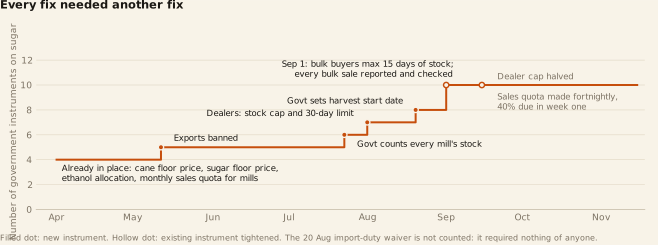
The staircase is the argument in one picture. Four controls existed before the season. Six were added between May and September and two existing ones tightened. Each reaches a decision the previous ones left alone. The state now has more administrative data and less market information, because the inventories that used to carry it are capped and the sales that used to carry it are scheduled.
India has been here before. In 2013, on the Rangarajan committee’s advice, it abolished levy sugar and the monthly release orders. In 2018, after a glut and unpaid cane dues, the release orders came back and the minimum selling price was created. Mises’s sequence was interrupted once, held five years, and resumed at the first crisis. It now reaches further than it did before 2013.
What follows
The case for freeing the sugar market makes no promise that prices would have stayed flat; a short crop raises prices in any system. The claim is narrower: the rise would probably have come earlier and smaller, traders would have held stock for the gap, and no new rules would have been left behind. It holds even if every official involved is able and honest. The missing ingredient was knowledge, which exists only in the heads of millions of growers, six hundred mills and the traders between them. The state’s response to its own ignorance was to forbid them to act on what they knew.
Freeing the market means: ending the statutory cane price and letting mills and farmers contract as in Brazil, where cane is paid on its sugar yield; abolishing the sugar tariff, so no ministry can waive it at discretion; no export licensing either way; repealing the stock limits, release quotas and sales verification, with a date; and publishing the audit.
The same applies beyond sugar. India has banned exports of wheat, rice and onions in recent years, lifted two of the three bans, and capped stocks of pulses, each time citing hoarders, and in each case the controls outlasted the price rise that prompted them. Mises’s sequence has no automatic stopping point; the one interruption on record, in 2013, followed a government-appointed committee’s report and lasted five years. The only durable way out is to decline the first step, and the first step, in every one of these markets, is the state’s decision that it knows what the price should be.