Lead Article
The Kids at Jantar Mantar Are Fighting the Wrong Enemy
The Delhi Police told them to take their grievance to Ramlila Ground. They sat at Jantar Mantar instead. No party will defend their demand, and every party wants quotas pushed into private companies. Their fight is just, but aimed at the wrong enemy.
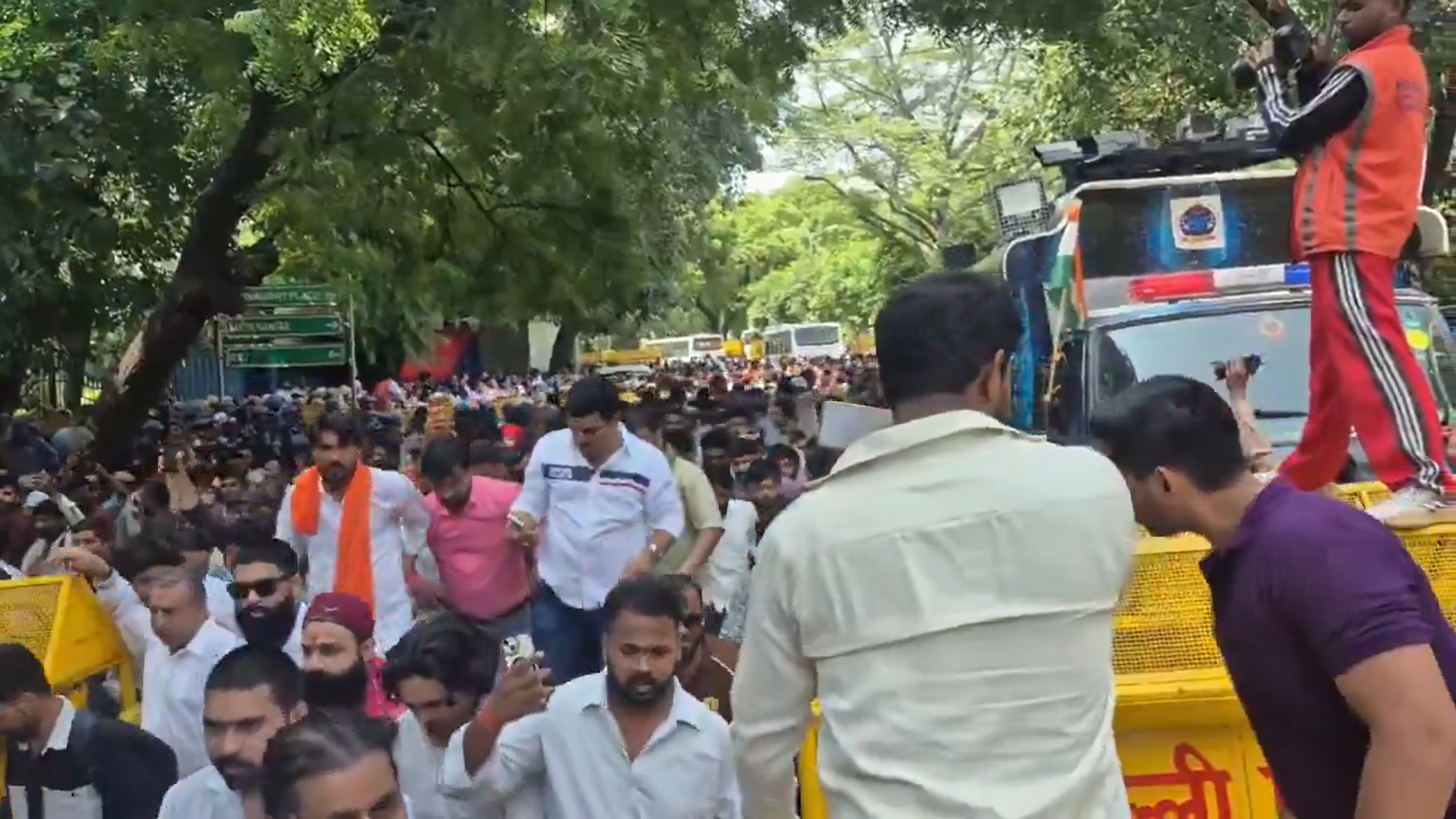
On Friday, August 21, the Delhi Police told the Reservation Hatao Andolan to take their grievance to Ramlila Ground, where grievances go to die quietly. They refused. They sat at Jantar Mantar under prohibitory orders, chanted the Hanuman Chalisa while being detained, and a movement that began as an Instagram page became, for a day, the only political question in Delhi.
The commentary since has been merciless in the usual key: casteist brats, defenders of privilege, a mob accused by activists of “weaponising competitive exam anxiety”.
The insults are the lesser wound. Within two days, Mayawati had declared the demand against the country’s interest, then turned her fire on the Congress for merely failing to show up and defend reservation to the protesters’ faces, reading absence itself as proof of an “anti-reservation mindset”. Such is the radioactivity of this issue that a party can now be denounced for standing near these young people, never mind with them.
No party will stand behind their demand; the Congress, the BJP, the BSP, the Left have each found their own reasons to refuse, and all of them arrive at the same silence. They are political orphans fighting a lonesome battle. My own view is harsher and kinder at once: these protesters are fighting a just fight against the wrong enemy, and the tragedy is that the wrong enemy is the only one our politics permits them to see.
The fight is just
Their fight is just, and pretending otherwise is dishonest. Reservation in India has never once contracted. It has grown for seventy-five years, category by category and percentage by percentage, and the frontier it is now crossing is the private sector itself. This is no fringe fantasy; Nitish Kumar has said plainly that he personally feels reservations should cover the private sector too. The late Ram Vilas Paswan demanded that every company taking government money be made to reserve posts. Salman Khurshid’s social-justice panel in the Congress formally sought quotas in private jobs. The CPI(M)’s latest party congress passed a resolution demanding reservation across the entire organised private sector, every registered company included. And lest anyone imagine the ruling coalition stands apart; Union Minister Anupriya Patel of the NDA spent 2024 demanding quotas in jobs outsourced to private contractors.
That list spans JD(U), LJP, Congress, the Left, and the NDA’s own council of ministers. Not one political party in India is arguing the other side. The entire electoral spectrum is bidding on the same auction, because promising someone else’s payroll costs a politician nothing. When every party pushes in one direction, the pushback has to come from outside the party system, from an Instagram page that grew legs. That is exactly what Jantar Mantar was. Structurally, this is the only fight these young people can fight, because no ballot offers them the choice. I will say what the respectable commentariat won’t: the tide has to be stemmed, and if the stemming must begin with detained twenty-somethings chanting the Hanuman Chalisa, the shame belongs to our party system far more than to them.
Suppose they win everything
And yet, having defended their fight, I must tell them they have picked a target that will break their hearts.
Suppose they win everything. It would take no amendment, and for the most part it would not even take Parliament. The Constitution’s reservation clauses merely permit quotas in education; they do not command them. The OBC and EWS quotas in the all-India medical seats were created by a government notification in July 2021, announced on a Thursday and notified by Friday, and what a ministry conjured by office memorandum a ministry could dissolve by office memorandum. Suppose the nerve appeared, and reservation vanished tomorrow.
Tomorrow morning, this year’s NEET cohort would still wake up to roughly 1.4 lakh MBBS seats, and even among the 11.2 lakh who qualified the exam, only about one in eight will ever sit in one. The queue would be exactly as long; only the sorting rule would change. The children of parents who can afford three years of Kota coaching would take the reserved seats along with the rest, the poor of every caste would remain outside, and within a decade a new andolan would occupy Jantar Mantar demanding the quotas back. Abolishing reservation without touching scarcity is rearranging the queue outside a shop that has been ordered, by law, to stay nearly empty.
- 1.4 lakh MBBS seats in the country, against 11.2 lakh candidates who cleared NEET
- 1 in 8 Qualified candidates who will ever occupy one of them
- ₹2 crore Alleged price of recognising a single medical college, over which the Medical Council’s president was arrested
A licensed commodity
That is the actual scandal, the one no protest has yet named. A college seat in this country is a licensed commodity. A medical college must beg a national regulator for permission to exist, permission for every batch, permission for every expansion. Readers old enough to remember waiting years for a Bajaj scooter or a telephone line know precisely what this system is. It is the licence raj, un-dismantled, now presiding over our children’s futures. We liberalised scooters in 1991 and the waiting list evaporated. We never liberalised college seats, and so the waiting list runs past twenty lakh names, and we have spent three generations knifing each other over the order of the names.
We even ran the experiment and then refused to learn from it. When engineering colleges were allowed to multiply in the 2000s, the scarcity inverted so completely that lakhs of seats went begging and hundreds of colleges shut for want of students. Tens of thousands of engineering seats, reserved and general alike, now find no takers even after the final round of counselling. The scarcity vanished, and the rage vanished with it. Nobody has ever marched on Jantar Mantar over a ration nobody wants. Meanwhile in medicine, where the permission desk still rules, the desk itself became so lucrative that the Medical Council of India had to be dissolved in disgrace after its president was arrested over an alleged ₹2 crore bribe for recognising a single college. Two crore rupees was the asking price of a permission slip. Artificial scarcity always finds its market rate, and every NEET aspirant pays it in a different currency.
A bigger demand
I say this to the Reservation Hatao Andolan as an ally rather than a scold. Your instinct is right. A quota regime that has only ever expanded, that every party in Parliament now wants to march into private companies, is a tide that must be stemmed, and you are the only ones standing in the water. But understand what feeds the tide. Reservation politics is savage in exact proportion to the scarcity of the prize. Politicians ration the seats, then win elections distributing the ration, then propose extending the ration to the private sector when the public trough runs dry. Fight only the distribution rule and you fight the tide wave by wave, forever; fight the rationing and you drain the ocean.
It is the licence raj, un-dismantled, now presiding over our children’s futures.
The next banner should not be a plea for a fairer list. It should be an eviction notice: the state will no longer decide how many chairs exist, and it will no longer decide whose names go on the private ones.
The first demand should be permission raj hatao: any institution meeting published standards may teach medicine, engineering, law, anything, with graduates certified by whichever examining bodies hospitals and patients come to trust, and nothing else standing between an Indian student and a chair. The second demand should be the liberation of the private college from quotas it never chose. A trust that raises its own money and builds its own campus is today compelled to surrender a large share of its seats to allocation by government exam and government category. The Supreme Court ruled in 2005 that this violated the autonomy of private unaided institutions; Parliament amended the Constitution within months to overrule the judges, and Article 15(5) has stood on the books ever since. The second demand even keeps the movement’s original slogan honest: reservation removed where the state had no business imposing it. Let seats multiply the way scooters did, and let the institutions that create them decide whom they admit. On the day 1.4 lakh medical seats become ten lakh, the question of who gets the reserved ones will bore everyone to death, the private-sector quota demand will lose its desperate constituency, and the politicians auctioning scarcity will find the lot has no bidders.
The young people at Jantar Mantar sat down in the right square for the right reasons. Next time, they should bring a bigger demand.